7 Leadership Moves That Actually Stabilize Your Team When Everything Has Changed
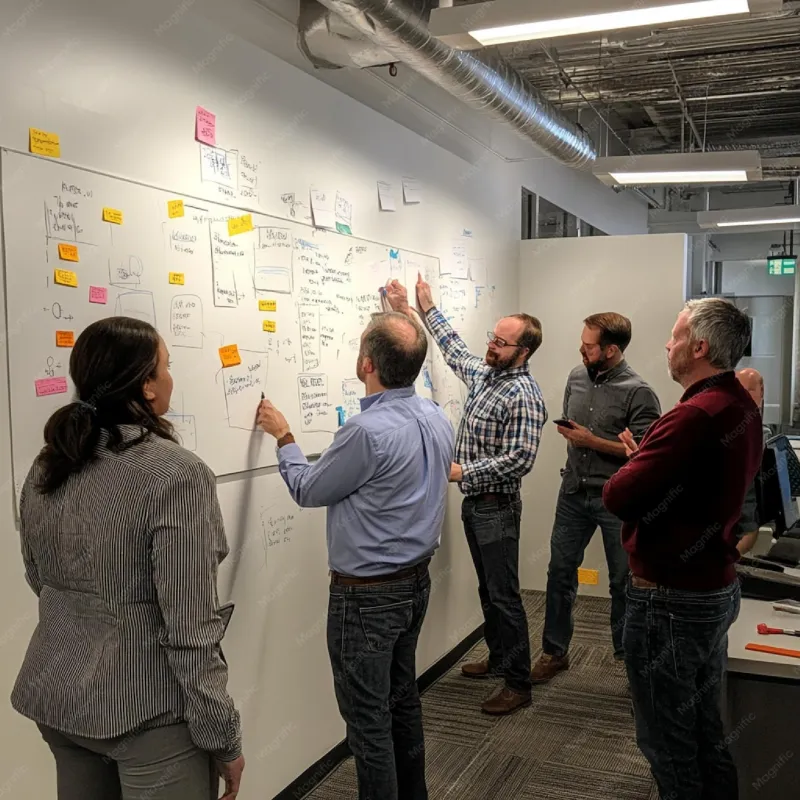
Photo: business team leader strategic meeting whiteboard collaboration office, via img.freepik.com
The Pivot Worked. Now What?
Your company made a bold move. Maybe you exited a product line, entered a new market, restructured the organization, or fundamentally reoriented your business model. The strategic rationale was sound. Leadership aligned. The announcement was made.
And now your team is looking at you with a mixture of uncertainty, exhaustion, and quiet skepticism—wondering whether the next shift is already being planned behind closed doors.
This is the post-pivot moment that most leadership playbooks skip. Organizations invest enormous energy in designing and announcing strategic transitions. Far fewer invest proportional energy in the recovery phase that follows—the period during which the people doing the actual work are trying to recalibrate, rebuild confidence, and figure out what their roles mean in the new order of things.
Leaders who navigate this phase well don't just preserve morale. They accelerate execution. The following seven moves are drawn from real-world leadership practice and are designed to address the human dynamics that determine whether a pivot actually delivers on its promise.
1. Name the Disruption Explicitly
One of the most counterproductive instincts leaders have after a major shift is to minimize the disruption in an effort to project confidence. Phrases like "this is actually a great opportunity" or "the fundamentals haven't changed" are well-intentioned—and deeply ineffective.
People know when things have changed. When leaders don't acknowledge that reality directly, it doesn't reassure the team. It signals that leadership is either out of touch or not being fully honest. Neither interpretation builds the trust you need for execution.
Instead, name what happened plainly. Acknowledge the uncertainty. Recognize that the transition requires adjustment. This kind of candor is not weakness—it is the foundation of credibility. Teams can handle hard truths far better than they can handle the disorienting experience of being managed away from them.
2. Rebuild Role Clarity Before Rebuilding Momentum
After a strategic shift, one of the most corrosive sources of anxiety is ambiguity about individual roles. When reporting structures change, priorities realign, or new initiatives replace familiar ones, people quietly wonder: Do I still have a place here? Does my expertise still matter? Who do I answer to?
Momentum cannot be rebuilt on a foundation of role confusion. Before pushing for acceleration, invest time in one-on-one conversations that clarify each team member's responsibilities, decision-making authority, and success metrics within the new strategic framework. This is not a bureaucratic exercise. It is a trust-building one.
Clarity is a form of respect. When people understand where they stand and what they own, they can lead themselves—which is exactly what you need when organizational demands are already high.
3. Communicate in Layers, Not Just Announcements
A single all-hands meeting is not a communication strategy. It is a starting point. Effective post-pivot communication requires a layered approach: organization-wide messaging followed by team-level conversations followed by individual check-ins.
Each layer serves a different function. The all-hands establishes the narrative and direction. Team-level conversations translate that narrative into functional relevance—what does this mean for how we work? Individual conversations address the personal dimension—what does this mean for me?
Leaders who treat the announcement as the communication often discover, weeks later, that their teams are operating on assumptions and informal interpretations rather than actual strategic guidance. Invest in the layers. Repetition is not redundancy when the context is change.
4. Identify and Protect Your High-Trust Connectors
Every organization has informal leaders—individuals whose credibility, relationships, and judgment make them trusted nodes in the social network of the workplace. These people are not always the most senior. They are often mid-level contributors who others naturally turn to for interpretation and reassurance.
During a strategic transition, these individuals are invaluable—and vulnerable. They absorb the anxiety of their peers while simultaneously trying to make sense of their own uncertainty. If they become disengaged or, worse, become sources of negative narrative, their influence can work against you.
Identify them early. Bring them into the conversation before the broader team. Give them context, not just information. Acknowledge their role explicitly. When high-trust connectors become active advocates for the new direction, organizational alignment accelerates significantly.
5. Create Deliberate Spaces for Psychological Safety
Pivots generate questions that people are often afraid to ask publicly. Will this affect my job? Is the company in trouble? What happens if this doesn't work? When those questions have no legitimate outlet, they don't disappear—they circulate in hallways, Slack channels, and informal gatherings, often gaining anxiety with each retelling.
Leaders who create structured, psychologically safe spaces for honest dialogue interrupt that cycle. This might look like small-group sessions where questions are genuinely welcomed, anonymous feedback mechanisms, or one-on-one conversations that begin with listening rather than messaging.
The goal is not to have all the answers. The goal is to demonstrate that uncertainty can be expressed without consequence. That signal alone significantly reduces the ambient anxiety that drains energy and focus during transitions.
6. Monitor for Burnout Before It Becomes a Crisis
Strategic pivots almost always increase workload in the short term. Legacy systems still need to be maintained while new ones are built. Teams are often asked to do more with the same resources while simultaneously absorbing the cognitive load of learning new priorities, tools, or processes.
Burnout during this phase is not a personal failing—it is a predictable organizational outcome when leaders don't actively manage capacity. Watch for the warning signs: declining quality of work, increased absenteeism, shortened tempers in collaborative settings, or a general flattening of energy and initiative.
The most effective intervention is proactive rather than reactive. Have explicit conversations about workload. Make visible trade-offs: if the new initiative is the priority, what comes off the plate? Protecting your people's capacity during a transition is not a concession to comfort—it is a prerequisite for sustained performance.
7. Celebrate Progress Publicly and Specifically
In the urgency of executing a new direction, leaders often defer recognition until outcomes are fully realized. That is a missed opportunity with real costs.
During periods of transition, people need evidence that their efforts are being seen and that progress is being made—even when the destination is still distant. Public, specific recognition of milestones, adaptations, and individual contributions provides that evidence. It also reinforces the behaviors and attitudes you want to see more of as the organization moves through change.
Generic praise lands flat. Specific acknowledgment—naming what someone did, why it mattered, and how it connects to the larger direction—builds both motivation and clarity simultaneously.
The Human Side of Strategy Is Strategy
Every major pivot carries two parallel challenges: the tactical challenge of executing a new direction and the human challenge of bringing people through the transition intact. Organizations that address only the first frequently find that the second undermines everything they built.
Leaders who invest in the human side of strategic change are not slowing down execution. They are making it possible. The seven moves outlined here are not supplemental to your post-pivot strategy—they are central to it. Because ultimately, your strategy is only as strong as the people willing to carry it forward.